
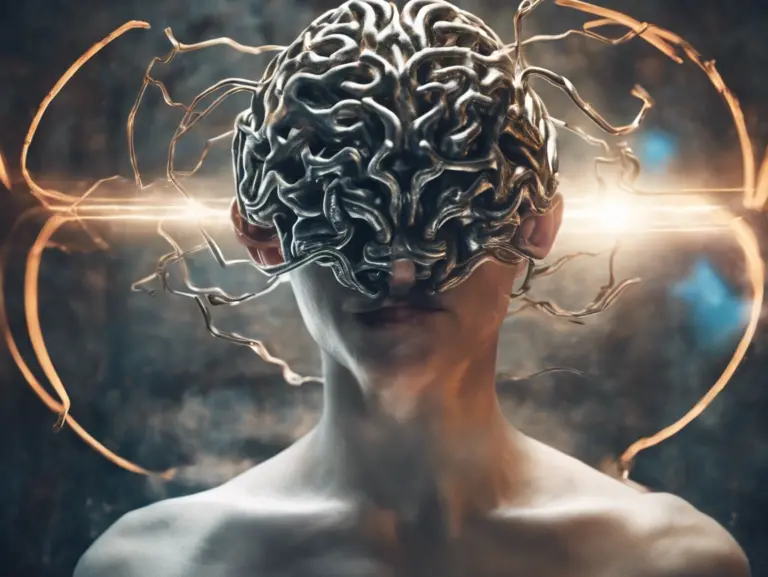
Let's discuss a vast topic, the "subconscious." After many studies of the human mind, it has been concluded that there is a part of it that acts independently of our will.
What is the subconscious? What is the conscious?

Source: The Subconscious – The Creator of the Reality You Experience (spandaproject.ro)
Maybe you've found yourself in places you didn't realize you were in, or you've found yourself in the middle of an action without realizing when you started doing it or why.
If this has happened to you, you've probably asked yourself the question "how?" and "why?" Well, researchers have come up with an answer to these questions, and it's called the "subconscious."
We don't have a concrete study that precisely states the percentage of the conscious part and the percentage of the subconscious part, but all researchers claim that the unconscious part is a higher percentage.
The conscious is the seat of reason, it is the part of the mind that acts and reacts to objective stimuli.
For example: you want to buy a decoration for your home and the interior designer recommends the color red, you go with his intuition without analyzing it.
The subconscious is the seat of emotions, beliefs, and memories from the past, it is the part of the mind that acts and reacts to subjective stimuli, that is, to stimuli related to an emotion.
For example: you want to buy a decoration for your home and the interior designer recommends the color red, but this color reminds you of an unpleasant moment in the past, so you will refuse the designer's suggestion. You will be led to make a choice influenced by an emotion.
During the intrauterine period, at the age of 3 weeks, the neural tube develops, the primitive form of the central nervous system, followed by the development of the circulatory system in weeks 4-5, and the first heartbeats of the baby in week 6 of pregnancy. From this we understand that the first to begin to develop is the nervous system.
The subconscious – the emotional part

Even from the mother's womb, we perceive her emotions and states. Many doctors suggest that mothers avoid stress factors and situations that can create emotions or states such as fear, anxiety, and many other low-frequency feelings because the child perceives them and is influenced by them.
It has been shown that when the mother experiences feelings of sadness, the baby cries in her womb.
It is the first touch with of the baby with the emotional side through the mother.
Later, when he comes into the world, he will experience many more emotions such as anger, sadness, joy, disgust, and fear.
He will attribute all these emotions to the different events that happen to him, based on which he will create his values and beliefs.
For example, if he puts his hand on the stove when it is hot, he will get burned, therefore he will associate that action with emotions such as fear, sadness, maybe even anger, but at the same time he will also make a correlation with physical sensations such as pain, burning, etc.
That experience with all its components, physical, emotional, and rational, will be stored somewhere so you can use it in similar situations in the future.
This is how we all learn to relate to life through the prism of personal experiences and what we have learned from them.
Later, perhaps in adolescence, you will have other types of experiences that you will relate to to create a set of values and beliefs that will help you in adult life.
For example, when you go through your first breakup, it is very important what conclusions you draw and how you relate to the event for the next ones.
If in this case a close person comes and tells you that it's not good to get attached because you're suffering to make yourself feel better, your brain will associate that person with pleasant feelings and you will appropriate that belief as your own because you believe that that person wants your best and in the long run you will store it and put it into practice without even realizing it and the question is: does anyone want to be in a relationship with an emotionally unavailable person?
I think your answer to this question was also "No", therefore, I think it would be helpful for you and your child to get some order in your emotions.
The subconscious – limiting beliefs
Limiting beliefs are beliefs that we formed at some point in our lives or that we unconsciously acquired from the external environment that prevent us from achieving what we want, being who we want, and reaching our maximum potential.
Most of the time it is a thought accompanied by a very strong emotion, which can be fear, for example.
Limiting beliefs can sometimes also act as defense mechanisms to protect us from pain, whether physical or emotional. Your subconscious remembers negative experiences from the past and tries to protect you from getting hurt again.
The first beliefs emerge and are established within the family.
Its members try to teach you certain things to have a better life or to raise you higher than they managed to reach, but not all of these teachings are healthy.
For example, if your grandparents pass on to your parents the belief that money is earned hard and with sacrifices, guess what?
You will internalize this belief and validate it constantly, perhaps through jobs where you work very hard for little money or perhaps through many other circumstances. If your family constantly hears "we don't have money," guess what? You will grow up to be an adult who will never have enough money.
How can you identify these conviction from the subconscious?

Pay attention to how you react and what you think when you are presented with a “challenge” such as a promotion at work, an opportunity for a new relationship or job. Analyze what your first impulse is upon hearing the challenge and what thoughts come to you that hold you back and write them down.
You can also make a list of things that seem challenging to you or that scare you and analyze each one to see where it comes from.
The good part is that we can, with a little work, eliminate these limiting beliefs and replace them with something positive that helps us.
You can break a limiting belief by putting yourself in that situation and showing yourself that it's not what you've believed for years.
If this is well-rooted in your subconscious, you can resolve it with the help of a therapist.
The subconscious – the archive of past memories
It happened to me that someone told me about a shared experience from the past and I didn't remember it, this is because the conscious part cannot store so many memories and at the same time store all the information that you learn throughout your life. If we could do that we would all be everything and nothing at the same time, and to understand this concept I invite you to watch the movie "Lucy".
Lucy – Trailer (Official – HD) (youtube.com)
The conscious mind processes everything that happened during the day, sends what is useful to the subconscious mind and gets rid of what is not useful to it.
The same principle also applies to painful memories. Following a traumatic event, there are situations in which the brain sends that memory to a corner of "oblivion" in order not to relive that pain, perhaps events from childhood or adolescence.
Forgetting painful memories without working through and processing them in therapy will unconsciously hold you back or cause you to continue your life in an unhealthy way.
Conclusion
I'm glad that more and more people are starting to be aware that their past influences their actions in the present and the way they perceive the future, and most are starting to take action in this regard to improve their lives.
It is an ongoing choice you need to make with yourself to heal and it is not an easy or quick process as most would like, but all I can tell you is that it is worth it.
It's worth working with yourself to have a more peaceful life and to pass on healthy values and beliefs to future generations so that they can leave life with a much easier path than it was for us.
If you also want to evolve, I'm here for you, just a click away.
With love,
Muammer!