

Maslow's pyramid is one of the most well-known explanations of human motivation. You see it in textbooks, psychology courses, leadership trainings, articles about personal development and discussions about relationships. The reason is simple: the model puts order into a question that every person asks, even if they don't formulate it academically: Why do I do what I do and why can't I focus on certain things when other needs are unmet?
In its classic form, Maslow's hierarchy of needs organizes human needs into five levels: physiological needs, safety, love and belonging, esteem, and self-actualization. The central idea is that basic needs tend to become more important when they are threatened, and higher needs become clearer when a person has sufficient stability, relationships, and self-respect.
This article explains Maslow's pyramid in a way that you can understand, with concrete examples, real-life applications, relationships, work, masculinity, and personal development. At the same time, it treats it with discernment: the pyramid is a useful model, but it is not a rigid law, it is not a diagnostic tool, and it does not guarantee happiness just because you "climb" from one level to another.
Direct answer: Maslow's pyramid is a psychological model of human needs, formulated by Abraham Maslow in 1943. It shows that people are motivated by basic needs, such as food, sleep, and safety, but also by psychological needs, such as love, belonging, respect, meaning, and the development of personal potential. Content
- What is Maslow's Pyramid?
- Who was Abraham Maslow?
- How does the hierarchy of needs work?
- The 5 levels of the pyramid
- Quick table: levels, needs, examples
- Real life examples
- How does it help you in personal development?
- The SCARA method
- 30-day plan
- Applications in relationships, work and leadership
- Common mistakes
- Criticisms and limitations
- Frequent asked questions (FAQs)
In short: Use the pyramid as a map of self-knowledge, not as a label. Ask yourself what real need is unmet, not just what goal you want to achieve. Sometimes you don't lack motivation, you lack sleep. Sometimes you don't lack discipline, you lack emotional security. And sometimes you don't lack ambition, you lack a meaning that is truly yours.
What is Maslow's Pyramid?
Maslow's pyramid, also called Maslow's hierarchy of needs or pyramid of human needs, is a model of human motivation. It explains that people are not driven solely by biological instincts, but also by abstract desires, ideals, and lofty goals. There are multiple layers of need in humans: the body wants survival, the mind wants predictability, the heart wants belonging, the identity wants respect, and the deeper part of the being wants meaning and the expression of potential.
The model was presented by Abraham H. Maslow in the article "A Theory of Human Motivation", published in 1943 in Psychological ReviewIn that article, Maslow talked about a positive theory of motivation and how certain needs become dominant when they are insufficiently satisfied. The DOI of the original paper is available here: 10.1037 / h0054346.
In popular culture, the model is represented as a five-tiered pyramid. At the base are physiological needs: food, water, sleep, air, shelter, rest. Next are safety needs: stability, health, protection, predictability, resources. Then come social needs: love, belonging, friendship, family, community. The fourth level includes esteem: self-respect, competence, recognition, status, and a sense of worth. At the top is self-actualization: developing one's potential, creativity, meaning, truth, autonomy, and contribution.
The important thing is not to understand it as a mechanical ladder. It is not as if a person must perfectly tick off every rung before they feel any higher need. A person can create art even if they are experiencing material difficulties. A person can love even if they do not feel completely safe. Someone can search for meaning in a time of crisis. However, the model remains valuable because it shows a direction: when the base is unstable, psychic energy is often spent on survival, control, validation, or anxiety.
For example, a man who sleeps little, eats poorly, has debt, and fears losing his job will not have the same inner availability for creativity, mature love, or spiritual development as he would during a period when his body and life are more stable. Not because he is "weak," but because his nervous system prioritizes safety.
Who was Abraham Maslow?
Abraham Harold Maslow was an American psychologist, born in 1908 and died in 1970. He is associated with humanistic psychology, a movement that attempted to view man not only through illness, conflict, and conditioning, but also through potential, growth, meaning, creativity, and psychological health.
Before humanistic psychology became influential, many explanations of human behavior were dominated by two major schools of thought: behaviorism, which emphasized stimulus, response, and learning through reward or punishment, and psychoanalysis, which emphasized unconscious conflicts, instincts, and early experiences. Maslow wanted to add a broader perspective: What motivates relatively healthy people? What makes a person grow? What does it mean to actualize one's potential?
This is where his model becomes very interesting for a reader concerned with masculinity, relationships and self-knowledge. Maslow did not see man simply as a sum of impulses. He saw in him a natural orientation towards development, but a development that needs conditions. When the body is exhausted, when life is chaotic, when man feels alone, rejected or worthless, his energy for growth can be blocked or distorted.
Maslow's work has become popular not only with psychologists, but also with educators, leaders, entrepreneurs, therapists, and people interested in personal development. Even though the theory has been criticized and revised, it remains a simple map for a complex reality: human needs for survival, security, love, respect, and meaning.
How does the hierarchy of needs work?
The hierarchy of needs starts from a simple idea: an unmet need tends to become a priority. If you are very hungry, hunger can dominate your thinking. If you feel in danger, safety becomes a priority. If you are isolated, rejection or loneliness can become painful. If you do not feel respected, you may begin to seek validation. If you have stability, love, and esteem, the question “what am I doing with my life?” becomes clearer.
In practice, the pyramid doesn't work like a building where you finish the ground floor and then never come back. Rather, it works like a living system. Sometimes you go up, sometimes you go down. Sometimes a financial crisis brings you back to safety. Sometimes a breakup brings you back to belonging. Sometimes an illness brings you back to the body. Sometimes professional success activates questions about meaning.
A mature way to use the pyramid is to see it as a gentle self-diagnostic tool: “What area is draining my energy the most right now?” If you’re anxious, maybe you don’t need another motivational quote, but more predictability. If you’re irritable, maybe you don’t need a sophisticated strategy, but sleep. If you’re entering relationships out of desperation, maybe you’re not looking for love, but for emotional regulation and belonging. If you’re obsessively chasing status, maybe there’s a self-esteem wound behind it.
For a real process of change, it is important to differentiate between need, desire and strategy. Need is deep: safety, love, respect, autonomy, meaning. Desire is a concrete form: I want a relationship, I want money, I want recognition. Strategy is the chosen path: I work harder, I enroll in courses, I approach people, I ask for help, I learn to communicate. Problems arise when we confuse strategy with need. If the strategy does not work, it does not mean that the need is wrong. It means that you need a more mature strategy.
Apply to you: If you feel like you're repeating the same blocks in relationships, money, discipline, or trust, work first with the real level of need, not just the symptom. You can start with a guided process of coaching or with the resources in the area courses.
The 5 levels of Maslow's pyramid
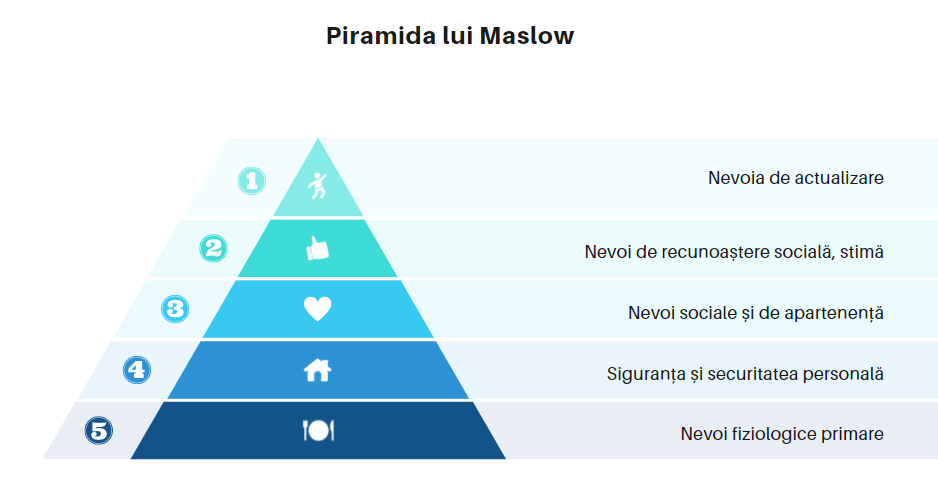
1. Physiological needs: the basis of the body
Physiological needs are the closest to survival. This includes air, water, food, sleep, shelter, body temperature, rest, basic movement, health, and biological sexuality. These are needs that you cannot negotiate indefinitely without consequences.
In personal development, this level is often overlooked because it seems too simple. Many people seek out productivity, motivation, seduction, meditation, or success techniques, but they sleep five hours a night, eat chaotically, and keep their bodies in a constant state of stress. Then they wonder why they don't have clarity, discipline, or energy.
A simple example: a man who wants to become more charismatic, but is constantly tired, will have difficulty being present, relaxed and attentive. Not because he doesn't know good lines, but because his system lacks resources. Masculine presence is not built only from techniques, but also from regulation, vitality and bodily stability.
At this level, the important questions are: Do I get enough sleep? Do I eat in a way that sustains my energy? Do I move my body? Do I give myself breaks? Do I ignore my physical signals? Do I use my body as a tool or treat it as a burden?
For the BarbatulSuperior audience, it's worth saying it directly: sometimes "I don't have motivation" means "I don't have physiological energy." Sometimes "I don't feel like people" means "I'm exhausted." Sometimes "I don't have confidence" means "my body is in a constant state of alert." Before positive affirmations, you need sleep, food, light, breathing, movement, and rhythm.
2. Safety needs: stability, protection and predictability
Based on the physiological basis, humans seek security. Security means physical protection, financial stability, health, order, predictability, boundaries, structure, clear rules, home, continuity, and the feeling that the world is not going to collapse overnight.
Safety needs are not just about money. Money can support safety, but safety also includes emotional stability, relationships where you don't walk on eggshells, an environment where you're not threatened, a schedule that doesn't destroy you, and the ability to say "no." A person can have money but not feel safe if they live in a chaotic relationship, in constant conflict, or in constant anxiety.
In real life, many personal development blocks are safety blocks. Someone says, “I want to follow my passion,” but inside they are afraid of being left without an income. Someone wants to open up emotionally, but they have learned that vulnerability is dangerous. Someone wants to start a relationship, but their body associates closeness with losing control.
At this level, useful questions are: What makes me feel insecure? Do I have a minimum financial plan? Do I have healthy boundaries? Do I live in an environment that stabilizes me or consumes me? Do I feel protected in my relationships? Can I express my needs without excessive fear?
If you work at self-esteem, safety is essential. It's hard to build self-esteem in an environment that constantly degrades you. It's hard to become relaxed and present in a relationship where you constantly anticipate rejection, criticism, or abandonment.
3. Needs for love and belonging: relationships, family, friendship, community
The third level refers to the human need to belong. We need to be seen, welcomed, loved, accepted, and connected. This includes family, friends, relationships, community, affiliation groups, and the feeling that we are not alone against the world.
This need is enormous, but it is often disguised. Some people say they want success, when they really want to be appreciated. Others say they want freedom, when they are really running away from intimacy. Others say they don't need anyone, but compulsively seek online validation, sexual attention, or social confirmation.
In couple relationships, the level of belonging is decisive. If a man does not feel loved and accepted, he can become defensive, jealous, cold, dependent, critical or withdrawn. If he feels that he has to play a role to be accepted, the relationship becomes a stage, not a space for intimacy.
For a man, one of the important things to grow is to acknowledge the need for connection without turning it into an addiction. It's not weak to need love. It only becomes problematic when you abandon your dignity for her, when you confuse the desire for closeness with control, or when you ask a woman to fix all the gaps you've never looked at.
Useful questions are: Do I have relationships where I can be authentic? Do I feel connected or just surrounded by people? Do I demand love through demands, withdrawal, or manipulation? Can I offer presence without becoming dependent? Am I in a community that grows me or in an entourage that keeps me in place?
4. Esteem needs: self-respect, competence, recognition
Self-esteem refers to how you see yourself and how you feel others see you. It includes self-respect, confidence, sense of competence, autonomy, dignity, recognition, reputation, status, and appreciation.
There is a subtle but very important difference here: Healthy self-esteem is not the same as external validation. Mature esteem is built from aligned behaviors, real competence, integrity, commitment, courage, and contribution. External validation can be nice, but it becomes fragile if it is the only source of value.
A man stuck in esteem may obsessively seek status, women, money, the perfect body, image, dominance, or admiration. Not because these things are bad in themselves, but because they can become attempts to fill a void. When inner worth is unstable, any external reaction feels like a sentence: if I am appreciated, I exist; if I am ignored, I am worthless.
In personal development, this level requires real work: becoming competent, keeping your promises, regulating your emotions, owning up to your mistakes, moving beyond victimization, building something, having standards, and respecting your boundaries. It’s not enough to repeat “I am valuable.” You have to live in a way that confirms your value.
Useful questions are: What gives me real self-esteem? Where do I seek validation instead of building value? What promises to myself do I keep breaking? What competency do I need to develop? What standards have I abandoned in order to be accepted?
5. Self-actualization needs: potential, meaning, creativity, truth
Self-actualization is the top of the pyramid in the classical model. It refers to the human desire to become what they can become, to use their talents, to create, to develop, to seek truth, meaning, beauty, contribution, and authentic expression.
This is the level at which a person no longer asks just "how do I survive?", "how do I protect myself?", "who loves me?" or "how do I prove my worth?". They begin to ask: "what is truly mine?", "what do I want to create?", "what can I offer?", "what kind of person do I want to become?", "what would my life look like if I were no longer building it solely out of fear?"
Self-actualization doesn't mean perfection. It doesn't mean you've resolved all your hurts, all your problems, and all your fears. It means you're starting to live more from inner direction than from reaction. It means your energy is no longer spent solely on survival, defense, validation, or adapting to the expectations of others.
This includes vocation, creation, healthy spirituality, study, contribution, art, entrepreneurship, mentoring, exploration, taking on a mission. For some people, self-actualization means building a conscious family. For others, it means creating a business. For others, it means writing, healing, educating, protecting, leading, or dedicating themselves to a cause.
Useful questions are: What do I feel is authentic to me? What would I create even if it weren't immediately applauded? Where do I betray myself for comfort? What part of me demands expression? What can I offer the world from what I have experienced, learned, and integrated?
Recommended resource: if you want to turn theory into practice, explore The Superior Man app, PAPER and programs courses for guided work on discipline, relationships, identity, and personal direction.
Quick table: levels, needs, examples
| Level | Main need | Concrete examples | Self-assessment question |
|---|---|---|---|
| 1. Physiological | Survival and energy | sleep, food, water, rest, health, shelter | Does my body have the resources or am I constantly pushing it? |
| 2. Safety | Stability and protection | money, house, limits, predictability, health, order | What makes me feel threatened or unstable? |
| 3. Belonging | Love and connection | family, friends, couple, community, acceptance | Where can I be authentic without playing a role? |
| 4. Esteem | Value and respect | competence, status, recognition, dignity, autonomy | Am I building my value or just seeking validation? |
| 5. Self-update | Meaning and potential | creativity, vocation, contribution, truth, development | What part of me is demanding to be expressed? |
Real life examples
Example 1: the man who wants success but has no foundation
Imagine a man who wants to grow professionally, have a good relationship, and be more disciplined. He reads books, listens to podcasts, and enrolls in classes, but he still can't seem to stick to it. If you look through Maslow's pyramid, you'll find that his main problem isn't a lack of ambition. The problem is the foundation: he sleeps little, eats chaotically, works without breaks, has financial anxiety, and lives in a state of alert.
For him, the first step is not to repeat to himself that he needs to be "stronger", but to stabilize his body and life. Sleep. Rhythm. Budget. Order. Limiting stimuli. A minimal routine. When the base becomes more stable, motivation does not need to be forced as much.
Example 2: the woman or man who is looking for love but needs security
A person may say, "I want a relationship." But if deep down their system associates closeness with danger, the relationship becomes a terrain of conflict. When the other person gets close, fear arises. When they get far away, panic arises. It's not just the level of love here; it's also the level of safety.
The pyramid helps you see that mature love requires emotional security. You can't build stable intimacy on chemistry alone. You need communication, boundaries, predictability, respect, and self-regulation. That's why many relationship problems aren't solved with romantic declarations alone, but with emotional maturity and consistent behavior.
Example 3: the man who has everything but feels no meaning
There are people who have money, a house, a family, status, and yet feel empty. On the outside they seem "fulfilled." On the inside they feel like they're living on autopilot. This is a good example of the self-actualization level. When the lower levels are sufficiently supported, the meaninglessness begins to hurt.
Here, comfort alone is not enough. Man needs to create, to contribute, to express himself, to live in accordance with his values. Perhaps he needs to change his professional direction, to start a project, to write, to work with people, to study, to dedicate himself to a cause, or to have the courage to tell the truth about his life.
How does Maslow's Pyramid help you in personal development?
Maslow's pyramid helps you stop treating all problems with the same tool. If your only solution is "I need to push harder," you'll push even when you need to rest. If your only solution is "I need to think positively," you'll ignore situations that actually threaten your safety. If your only solution is "I need to be independent," you'll repress your healthy need for connection. If your only solution is "I need to be successful," you can turn esteem into an endless hunger for validation.
The model helps you ask better questions. Not just “how do I get rid of the problem?” but “what need is this problem trying to show me?” Lack of discipline can indicate fatigue, meaninglessness, fear, chaos, or shame. Jealousy can indicate insecurity, anxious attachment, unstable self-esteem, or lack of communication. Procrastination can indicate fear of failure, incompetence, perfectionism, or goals that are not yours.
In a personal development journey, the pyramid can be used as a prioritization map:
- If you're exhausted, start with your body.
- If you're anxious, check for safety and predictability.
- If you are lonely or disconnected, work on belonging and relationships.
- If you feel worthless, build competence and self-respect.
- If you have stability but feel empty, seek meaning, creation, and contribution.
That's the difference between superficial personal development and real personal development. The former gives you lines and techniques. The latter teaches you to see the inner structure of your life.

The SCARA method: how to apply the pyramid to yourself
To ensure that Maslow's pyramid does not remain just a theoretical scheme, you can use the method SCALE It is a simple self-assessment method, built on the logic of the five levels.
S — Stabilizes the body
Start by asking yourself, “What does my body need?” Don’t skip this step. Note how you’re doing with sleep, nutrition, energy, movement, breathing, muscle tension, and health. If your physiological foundation is weak, many goals will seem harder than they are.
Practical action: For seven days, track your bedtime, number of actual meals, energy levels, and times when you become irritable. Don't moralize. Observe.
C — Clarify safety
Ask yourself, “Where do I feel unsafe?” It could be money, job, home, health, boundaries, family, relationships, or the future. Safety isn’t about controlling everything, it’s about creating enough structure so that your system isn’t constantly on alert.
Practical action: make a list of three things that increase your predictability: a simple budget, a clear conversation, a limit, a routine, a medical appointment, a deferred decision.
A — Get close to the right people
Ask yourself, “Where do I feel real belonging?” Don’t confuse social contact with intimacy. You can talk to people every day and still feel lonely. Seek out relationships where you can be honest, not just helpful, funny, or accomplished.
Practical action: Choose one person you can have an honest conversation with this week. Don't start with drama. Start with truth: "Look what's happening to me right now."
R — Recognize value through behavior
Ask yourself, “What behavior would increase my self-respect?” Self-esteem isn’t built through thoughts alone. It’s built through repeated actions that show you can trust yourself.
Practical action: choose a small promise and keep it for seven days. Don't choose something spectacular. Choose something small enough that you can't lie to yourself: 20 minutes of exercise, a page written, a conversation avoided, a boundary respected.
A — Update potential
Ask yourself: “What is life trying to express through me?” It may sound poetic, but the question is very practical. What talent do you keep putting off? What project do you keep putting off? What truth do you keep avoiding? What would you do if you were no longer building for approval?
Practical action: set aside two hours a week for a self-actualization activity: creation, study, personal project, writing, mentoring, art, entrepreneurship, or a real contribution.
30-day pyramid plan
This plan doesn't promise magical transformations. It's a simple structure that lets you see where you're out of balance and what you can stabilize.
Days 1-7: body and energy
In the first week, don't start with big goals. Observe your body. Regulate your sleep as much as you can. Reduce your food cravings. Go for a walk. Drink water. Note the times when your energy drops. Ask yourself: "What I call lack of motivation, but is actually exhaustion?"
Days 8-14: safety and order
In the second week, look at the things that give you anxiety. Make a simple budget. Clarify a responsibility. Clear a space. Set a boundary. Resolve an administrative procrastination. Security increases when life becomes less ambiguous.
Days 15-21: relationships and belonging
In the third week, notice the quality of your connections. Who are you avoiding? Who are you seeking out just for validation? Where can you be honest? Choose a real conversation. Say something true without accusing. Listen without preparing a counterattack.
Days 22-26: esteem and competence
Choose a skill that matters to you. It could be communication, discipline, sports, money, mature seduction, public speaking, writing, a professional skill. Work on it a little every day. Esteem changes when you start seeing yourself taking action, not just wishing.
Days 27-30: meaning and self-actualization
In the last few days, ask yourself, “What direction would I be heading if I wasn’t driven solely by fear?” Write a page about the life you want to build. Not as a fantasy, but as a direction. Choose a concrete step for the next month.
Important: If you experience severe anxiety, depression, trauma, thoughts of self-harm, or difficulties that affect your daily functioning, seek professional support. Maslow's pyramid can be a map for reflection, but it is not a substitute for therapy, medicine, or specialist intervention.
Applications in relationships, work and leadership
In relationships
In relationships, Maslow's pyramid helps you see what's hiding beneath the conflict. Sometimes partners argue about dishes, text messages, or time spent together, but behind it are deeper needs: safety, belonging, respect, autonomy, or recognition.
For example, a woman may say, “You don’t listen to me,” but the real need may be for belonging: she wants to feel important. A man may say, “You control me,” but the real need may be for autonomy and respect. An argument about money may actually be an argument about safety. An argument about friends may be an argument about belonging or boundaries.
When you learn to listen to the need behind the behavior, communication becomes more mature. You no longer just react to the tone, but try to see what need is being threatened. This doesn't mean justifying toxic behavior. It means responding more consciously.
In masculinity
For a man, the pyramid can become a map of maturation. At the base is the body: vitality, health, energy, physical discipline. Then safety: resources, order, boundaries, the ability to protect without obsessive control. Then belonging: friends, tribe, intimacy, relationship. Then esteem: competence, dignity, earned status, self-respect. At the top: mission, meaning, creation, contribution.
Healthy masculinity doesn't skip over the lower levels to appear spiritual, nor does it get stuck in survival, money, or status. It integrates body, security, heart, competence, and meaning. That's why a mature man is not just strong. He's also present, connected, responsible, capable of loving, and capable of creating.
At work and in leadership
In organizations, Maslow's pyramid is frequently used to understand employee motivation. A person who does not feel safe at work will not be motivated by inspirational speeches alone. An employee who does not feel a sense of belonging may become disengaged. Someone who does not receive recognition may seek another environment. And highly competent people may leave if they no longer see meaning and growth.
For leaders, the practical question is, “What level of need is being ignored in our culture?” If people are underpaid, the problem is the base. If they are afraid to speak up, the problem is psychological safety. If there is no team, the problem is belonging. If their work is not recognized, the problem is esteem. If they lack autonomy and meaning, the problem is self-actualization.
In education
In education, the model explains why students cannot learn effectively when basic needs are ignored. A hungry, scared, humiliated, or isolated child is not as ready to learn as one who feels safe and supported. Before performance, there are human conditions.
Common mistakes in interpreting the pyramid
Mistake 1: Thinking the pyramid is rigid
Many people believe that you have to completely satisfy one level before you can move on to the next. In reality, life is more fluid. You can have needs on multiple levels at the same time. You can seek meaning even if you are still working on security. You can love even if you have insecurities. You can create even if everything is not stable.
Mistake 2: Using the pyramid as a judgment
The pyramid is not a ranking of human worth. If someone is concerned with money, food, or stability, they are not “inferior.” They are at a stage or in a context where those needs are dominant. Judgment doesn’t help. Clarity does.
Mistake 3: Confusing esteem with status
Status can support esteem, but it cannot replace it. There are people with high status and fragile esteem. There are simple people, but with deep dignity. Real esteem is built through congruence: what you say, what you do, what you choose, and what you accept.
Mistake 4: Spiritualizing the lack of foundation
Sometimes people jump straight to meaning, spirituality, or mission to avoid concrete realities: debt, chaos, neglected bodies, toxic relationships, lack of boundaries. Self-actualization is not running away from life. It is deeper integration of life.
Mistake 5: Using theory for manipulation
In marketing, leadership, or relationships, the pyramid can be misused to tap into fears and insecurities. Ethically, it should be used for understanding and support, not control. Understanding human needs does not give you the right to manipulate people through them.
Criticisms and limitations of Maslow's pyramid
Maslow's pyramid is influential, but it's not perfect. Modern criticism is important, especially if you want to use the mature, non-dogmatic model.
The first criticism is that the hierarchy may be oversimplified. People do not live in five separate boxes. Needs intermingle, influence each other, and depend on culture, personality, life history, trauma, social context, and relationships.
The second criticism is related to universality. The model is popular in Western culture, where the emphasis on individuality and self-actualization is very strong. In other cultures, belonging, family, or duty to the group may be prioritized in a different way. Not all people define “fulfillment” as an individual expression of potential.
The third criticism is that empirical research does not always confirm a strict hierarchy. Louis Tay and Ed Diener's study of needs and subjective well-being, conducted on data from many countries, shows that the satisfaction of needs is associated with well-being, but not in a simple and rigid pattern for everyone. You can read the summary of the research here: Needs and Subjective Well-Being Around the World.
The fourth criticism is that the classical model can be complemented by newer theories of motivation. For example, the self-determination theory, developed by Richard Ryan and Edward Deci, emphasizes three fundamental psychological needs: autonomy, competence, and relatedness. The official source about this theory can be consulted here: Self-Determination Theory.
Another direction of revision appears in the article "Renovating the Pyramid of Needs", where researchers discuss the pyramid from the perspective of evolutionary psychology and propose adjustments to the classic model. The fact that the theory is revised does not make it useless. It makes it alive. Good models should not be idolized; they should be used with discernment.

Comparison: Maslow and self-determination theory
Maslow's pyramid says: people have levels of needs, from basic physiology to meaning and potential. Self-determination theory says: people function best when their autonomy, competence, and relatedness are supported. The two perspectives don't necessarily have to be pitted against each other. They can complement each other.
Maslow is useful when you want to see which layer of life is unstable. Self-determination is useful when you want to understand the quality of motivation. For example, you can have financial security and still be unhappy if you don't have autonomy. You can have recognition and still feel empty if you don't have real relationships. You can have belonging and still feel stuck if you don't develop your competence.
For personal development, the combination is powerful. Ask yourself, “What level of the pyramid is unstable?” Then ask yourself, “Do I have autonomy, competence, and healthy relationships in this area?” The answers will be much clearer than a simple “I need to be more motivated.”
Recommended books and readings
If you want to delve deeper into the topic, start with primary sources and then move on to modern interpretations:
- Abraham H. Maslow, Motivation and Personality — important work for understanding motivation and self-actualization.
- Abraham H. Maslow, Towards a Psychology of Being — useful for the humanistic perspective on growth and potential.
- Original article "A Theory of Human Motivation" — the basis of the theory.
- Douglas T. Kenrick and collaborators, "Renovating the Pyramid of Needs" — a contemporary revision.
- Richard M. Ryan and Edward L. Deci — works on self-determination theory, autonomy, competence, and relatedness.
If you want practical direction, don't just read. Choose a level of the pyramid and work with it concretely for 30 days. Reading gives you clarity. Practice changes your life.
Self-assessment: where are you now on Maslow's pyramid?
A good question is worth more than a hasty conclusion. When using Maslow's pyramid on yourself, don't start with the verdict "I'm stuck at level X." Start with observation. Your life may look good on the outside, but on an inner level it may be tense. Or vice versa: you may be going through a difficult time, but you have a very clear direction and a real capacity for growth.
Take each level and rate it from 1 to 10. Don't rate how good you look to others, but how supported you feel. For physiological needs, ask yourself if you have energy, sleep, food, rhythm, and touch with with the body. For security, ask yourself if your life has enough stability, boundaries, and predictability. For belonging, ask yourself if you have relationships where you can be seen. For esteem, ask yourself if you have self-respect built through action, not just image. For self-actualization, ask yourself if you are living in touch with your meaning, vocation, and potential.
Once you’ve written it down, don’t try to fix everything at once. Choose the lowest-scoring level and ask yourself, “What is the smallest step that would produce more stability here?” If you’re a 4 in body, don’t start with an extreme schedule. Start with bedtime. If you’re a 3 in safety, don’t ask for abstract courage. Make a budget, ask for clarification, set a limit. If you’re a 2 in belonging, don’t rush into a relationship out of emotional hunger. Start with honest conversation and a healthier environment.
This self-assessment becomes powerful when you repeat it monthly. Not to obsessively control yourself, but to see trends. You may find that every time your sleep decreases, your self-esteem also decreases. You may find that when you lack belonging, you seek sexual validation. You may find that when you lack meaning, you compensate through consumption, overwork, or comparison.
Journal questions
- What need am I trying to satisfy through my current goal?
- What need do I refuse to acknowledge because it seems “weak” to me?
- Which level of the pyramid is the most stable in my life right now?
- Which level is the most fragile?
- What do I confuse with love, but is it actually a need for security?
- What do I confuse with ambition, but is it actually a need for validation?
- What do I confuse with freedom, but is actually a fear of closeness?
- What specific behavior would increase my self-respect in the next 24 hours?
What do you do when a level is unbalanced?
If your physiological level is out of balance, don't argue with yourself. Your body doesn't need harsh speeches, it needs rhythm. Choose three simple things: go to bed earlier, eat cleaner meals, and move lightly. Don't turn the foundation into a new reason for perfectionism. The goal is not to become a robot, but to regain your energy.
If your safety level is out of balance, look at the areas of chaos. Financial chaos, relationship chaos, schedule chaos, boundary chaos. Safety increases when things become named. What scares you? What are you avoiding? What conversation needs to be had? What decision needs to be made? What minimal plan would help you?
If your level of belonging is unbalanced, don't isolate yourself in the name of independence. Mature independence doesn't mean you don't need anyone. It means you can choose relationships without abandoning yourself. Seek out people with similar values, build real friendships, ask for support, offer support, and learn to be there without being controlling.
If your esteem is out of balance, stop blindly hunting for validation. Ask yourself where you need real competence. If you want respect, build something respectable. If you want trust, keep small promises. If you want dignity, stop negotiating with things that violate your values.
If your level of self-actualization is out of balance, perhaps you don't need more comfort, but more truth. What path is no longer yours? What role are you playing too much? What talent have you left behind? What contribution are you postponing? Sometimes the emptiness within is not a lack of gratitude, but a call to a new stage.
Maslow's pyramid and personal goals
A goal is easier to achieve when you know what need it feeds. If you want money just to prove something, you will have a strained relationship with money. If you want a relationship just to not feel lonely, you can become addicted. If you want a better body just to be accepted, you can turn sports into a punishment. If you want status just to cover up shame, success will not calm you for long.
Before you set a goal, ask yourself, “What need am I trying to satisfy?” Then, “Is there a more mature strategy for this need?” For example, the need for esteem can be satisfied through competence, not just image. The need for belonging can be satisfied through community and friendship, not just romantic relationships. The need for safety can be satisfied through boundaries and planning, not just control.
Mature goals are those that support life, not those that compulsively compensate for it. If a goal makes you more present, more engaged, healthier, and more connected, it's probably aligned. If it makes you more anxious, more dependent on validation, more disconnected from your body, and more distant from people, it's worth revisiting.
How does this model fit into coaching work?
In coaching, Maslow's pyramid can be used as a clarifying tool. A client may come in with a discipline problem, but the process may reveal that they have a safety problem. They may come in with a relationship problem, but underneath it may be a esteem problem. They may come in with a career problem, but deep down it may be a need for meaning and self-actualization.
A good process doesn't put quick labels on things. It asks questions, looks for patterns, and looks for the level at which the intervention has the greatest effect. If you only work at the top, but the base is unstable, change won't stick. If you only work at the bottom, but ignore meaning, life can become functional but empty.
That's why an article about Maslow's pyramid shouldn't just be informative. It can become a bridge to practice: see where you are, choose a step, apply it, notice what changes. That's living personal development, not memorized theory.
Frequently Asked Questions about Maslow's Pyramid
1. What is Maslow's Pyramid?
Maslow's hierarchy of needs is a model of human needs that explains motivation through five levels: physiological needs, safety, love and belonging, esteem, and self-actualization. The model shows that basic needs become more important when they are threatened, and higher needs become clearer when a person has stability.
2. What are the 5 levels of Maslow's pyramid?
The five levels are: physiological needs, safety needs, love and belonging needs, esteem needs, and self-actualization needs. They describe the transition from survival to meaning and the expression of personal potential.
3. Who created Maslow's pyramid?
The model is associated with Abraham H. Maslow, an American psychologist and a major figure in humanistic psychology. The theory was presented in the article "A Theory of Human Motivation", published in 1943.
4. Is Maslow's pyramid a valid theory?
It is an influential theory and useful as a map for reflection, but it should not be treated as a rigid law. Modern research supports the importance of needs for well-being, but shows that their order and manifestation can vary depending on the person, culture, and context.
5. Do you have to completely satisfy a level before moving on to the next?
No. This is one of the most common misconceptions. In real life, people can have needs active on multiple levels simultaneously. However, when basic needs are threatened, they tend to consume more psychic energy.
6. What does self-actualization mean?
Self-actualization means expressing your personal potential. It can include creativity, meaning, vocation, contribution, inner truth, autonomy, and developing talents. It does not mean perfection, but a life more aligned with who you are and can become.
7. How does the pyramid help me in personal development?
It helps you identify the true level of the blockage. You may discover that the problem is not a lack of motivation, but fatigue; not a lack of love, but insecurity; not a lack of value, but a lack of competence built through action.
8. How is the pyramid applied in relationships?
In relationships, the pyramid shows that many conflicts hide needs for safety, belonging, respect, or autonomy. When partners learn to see the need behind the reaction, communication becomes more mature and less defensive.
9. Does Maslow's pyramid also apply to work?
Yes. In work, people need salary and stability, but also psychological safety, team membership, recognition, autonomy and meaning. A good leader does not motivate with money alone, but creates an environment where multiple levels of need are supported.
10. What is the difference between need and want?
The need is deep and universal, such as security, love, or respect. The desire is the concrete form in which you believe you can satisfy that need. For example, the need may be belonging, and the desire may be a relationship.
11. Why is Maslow's pyramid criticized?
It has been criticized for its simplification, its assumption of a universal order, and its lack of full empirical confirmation of its rigid hierarchy. However, it remains useful as an introductory model and tool for self-knowledge.
12. What is the connection between Maslow's pyramid and self-esteem?
Esteem occurs at the fourth level and includes self-respect, competence, recognition, and a sense of personal worth. Healthy esteem is built through congruent behaviors, not just external validation.
13. Can someone achieve self-actualization without a lot of money?
Yes. Self-actualization doesn't mean luxury or financial status. However, a modicum of stability helps. When survival is constantly threatened, the energy for creation and meaning can be much harder to access.
14. Which level is the most important?
The most important level is the one that is most unfulfilled at the moment. If you are exhausted, the body is a priority. If you are scared, safety is a priority. If you are lonely, connection becomes a priority. If you have stability, the need for meaning may arise.
15. How do I use the pyramid without judging myself?
Look at it as a map, not a verdict. Ask yourself what needs attention and what small step you can take. Don't label yourself as "blocked" or "inferior." Every person periodically returns to certain levels, depending on life, context, and stage.
Conclusion
Maslow's pyramid remains valuable not because it perfectly explains man, but because it makes him easier to understand. It shows you that behind your behaviors there are needs. Sometimes you need rest, not pressure. Sometimes you need security, not shame. Sometimes you need love, not a mask. Sometimes you need self-respect, not applause. Sometimes you need meaning, not another checked-off goal.
Use the pyramid as a mirror. Look honestly at the foundation of your life, your relationships, how you build your value, and what wants to express itself through you. You don't have to climb perfectly. You have to become more aware, more committed, and more aligned.
If you want to move forward, start simple: choose the level that consumes the most energy for you right now and take a concrete step in the next 24 hours. You don't change your life through theory, but through clearly seen truth and repeated behaviors.
Next step: if you want to work hard on discipline, relationships, self-esteem, and personal direction, check out the BarbatulSuperior resources: coaching, courses, application and carte.
External sources and readings
- Abraham H. Maslow, A Theory of Human Motivation, 1943.
- TWO original Maslow articles: 10.1037 / h0054346.
- Douglas T. Kenrick, Vladas Griskevicius, Steven L. Neuberg, Mark Schaller, Renovating the Pyramid of Needs.
- Louis Tay and Ed Diener, Needs and Subjective Well-Being Around the World.
- Self-Determination Theory, Basic Psychological Needs Theory.